Gulf Arabic vs. Modern Standard Arabic: Which One Should You Learn?
Arabic
7 min read
Sep 27, 2026
If you've looked into Arabic classes, you've probably hit this question fast: should you learn "Arabic," or specifically Gulf Arabic? The honest answer is that these aren't two versions of the same thing - they're two different tools that do different jobs, and most native speakers use both.
Understanding the split now saves you from picking a course that doesn't actually match what you need.
Two languages doing two different jobs
Arabic works on what linguists call diglossia - one language, two clearly separate registers used for different purposes:
- Modern Standard Arabic (MSA) - the standardized written and formal-speech form used across the entire Arab world. Nobody grows up speaking it at home.
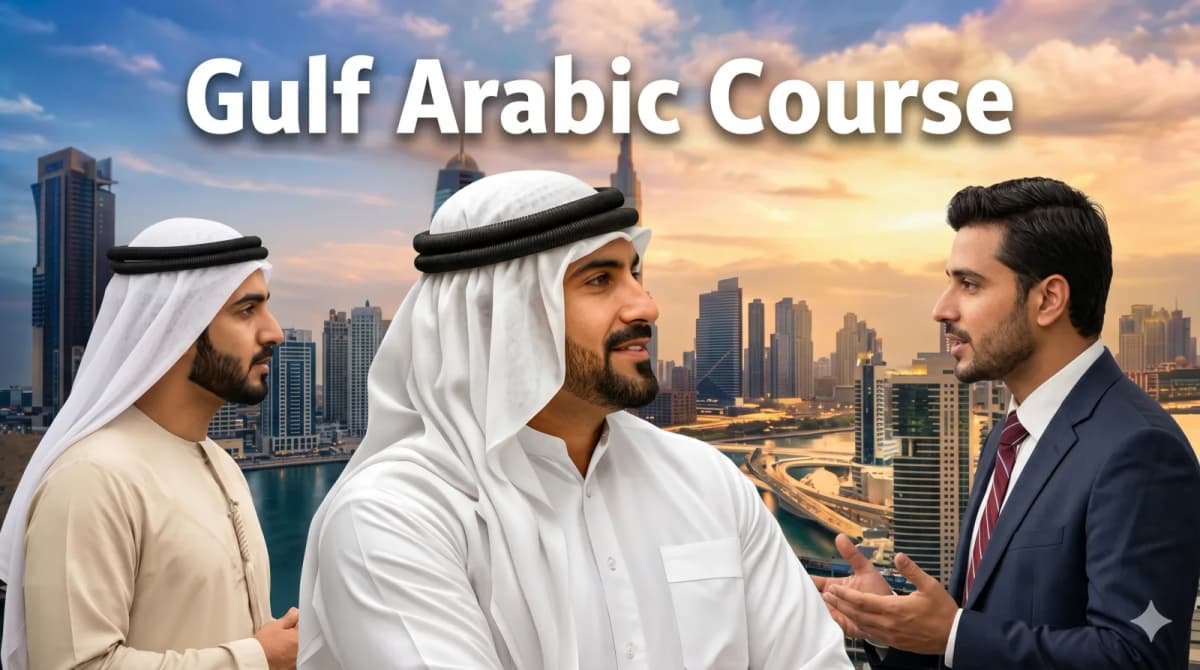
- Gulf Arabic (Khaleeji) - the everyday spoken dialect used across the UAE, Saudi Arabia, Qatar, Kuwait, Bahrain, and Oman. This is what people actually speak with family, friends, and colleagues.
Every Arab country has its own spoken dialect like this - Egyptian, Levantine, Gulf, and others all sit alongside the same shared MSA.
Where you'll actually hear each one
MSA shows up in the news, official documents, books, formal speeches, religious sermons, and most school instruction. Gulf Arabic is what fills a majlis conversation, a market haggle, a work meeting in Dubai or Riyadh, or a voice note between friends. If your goal is watching the news or reading a newspaper, that's MSA. If your goal is actually talking to people day to day in the Gulf, that's Gulf Arabic - and the two can sound surprisingly different side by side.
Sound and vocabulary differences worth knowing
A few patterns explain most of the gap a learner notices:
- Simplified grammar: Gulf Arabic drops most of MSA's formal case endings and some verb conjugation patterns, which is part of why it's often quicker to become conversational in.
- The ق sound: pronounced as a hard "q" in MSA, but frequently shifts to a "g" sound in Gulf Arabic - so "qaal" (he said) in MSA becomes "gaal" in everyday Gulf speech.
- Everyday vocabulary: greetings, small talk, and daily-life words often differ completely - "how are you" is "kayfa haaluka" in MSA but "shlonak" in Gulf Arabic.
None of this makes Gulf Arabic a "broken" version of MSA - it's a full, complete spoken language with its own consistent grammar, it's just not the same system as the written standard.
Is one more "correct" than the other?
No. MSA is the shared written/formal standard that connects the whole Arab world - useful precisely because it isn't tied to one country. Gulf Arabic is what Gulf Arabs actually grow up speaking. Neither replaces the other; they're used for different situations by the same people, often within the same conversation.
Which one should you learn?
It comes down to what you're actually going to do with it:
- Choose Gulf Arabic if you're living, working, or doing business in the GCC, or building relationships with Gulf Arab friends and family - this is what you'll hear and need to respond to day to day.
- Choose MSA if your priority is reading news and books, studying the Quran and classical texts, formal writing, or speaking with Arabic speakers from outside the Gulf where MSA is the common bridge.
- Learning both is common for anyone who wants full fluency - most Gulf Arabs grow up doing exactly that.
Which one do we teach?
Our Gulf Arabic Course focuses specifically on the spoken Khaleeji dialect used daily across the GCC, so you can actually hold a conversation - not just read one. If you're starting from zero and want a broader foundation first, our Arabic Beginner Course is the place to start.

Mohsin Ali
Founder of LanguagesTutor
With over a decade of expertise, Languages Tutor provides high-quality, affordable online education in Pashto, Urdu, Arabic, and English. Our certified native teachers deliver personalized, one-on-one classes to students in the USA, UK, Canada, and Australia. We are committed to making language and Islamic courses accessible to learners of all ages, fostering both cultural understanding and personal growth.
You can learn more about me on:

Frequently asked questions


Explore Our Language Learning
Tips, Guides, and Success Stories

Join our newsletter
Get the latest updates, exclusive offers, and more straight to your inbox!
By subscribing you agree to our Privacy Policy and consent to receive updates from LanguagesTutor. Spam-free and un-subscribe anytime.