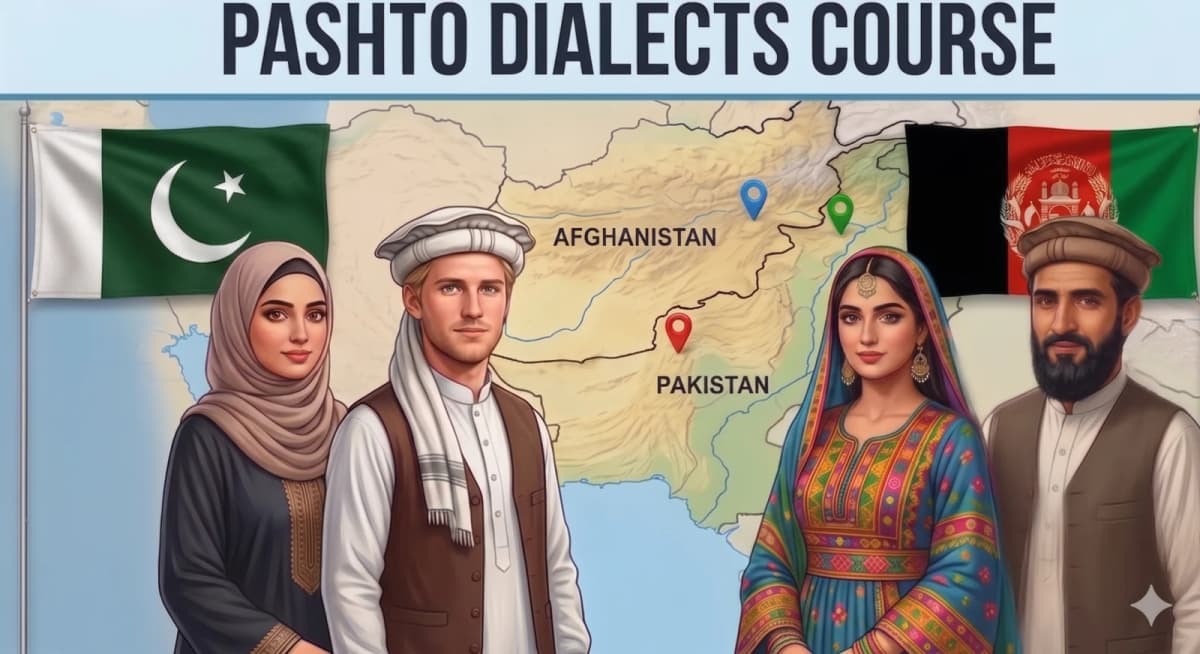
If you've started looking into Pashto classes, you've probably run into the same question early on: which Pashto? Pakistani or Afghan? The honest answer is that Pashto isn't one flat dialect any more than English is - and the differences are real enough that a learner who only trains on one side can genuinely struggle to follow the other at first.
This isn't about picking a "correct" version. It's about knowing what you're learning, so nothing catches you off guard.
Two dialect families, not two languages
Linguists usually group Pashto varieties into two broad families:
- "Hard" Pashto (Southern/Western) - centered on Kandahar and much of southern and western Afghanistan. Often treated as the more conservative, literary form.
- "Soft" Pashto (Northern/Eastern) - centered on Peshawar and most of Pakistan's Pashto-speaking regions, plus parts of eastern Afghanistan (Jalalabad).
There are more regional varieties inside each family - Waziri, Bannuchi, Wardak, and others each have their own texture - but the hard/soft split is the one that actually changes how a word sounds to a learner's ear.
The name itself is the clearest example
This is the single easiest way to hear the difference: the language's own name is pronounced differently depending on which side you're learning from.
DialectHow the language name soundsTypical region Hard PashtoPakhtoKandahar, southern/western Afghanistan Soft PashtoPashtoPeshawar, most of Pakistan, JalalabadThat "kh" vs "sh" swap isn't limited to the name - it shows up across a whole set of everyday words, because it comes from how each dialect pronounces a specific Pashto letter (ښ).
Sound differences worth knowing before you start
A few consistent patterns make the biggest practical difference for a learner:
- ښ (the "kh/sh" letter): pronounced closer to "kh" in hard dialects, closer to "sh" (or a soft retroflex) in soft dialects.
- ژ / ږ: similarly split between a harder, more guttural sound in the south and a softer sound further north and east.
- ts/dz vs s/z: some consonant clusters that stay as "ts" or "dz" sounds in hard Pashto simplify toward "s" and "z" in soft Pashto - part of why hard dialects can sound more consonant-heavy to a new listener.
None of these differences change the grammar. A sentence built correctly in one dialect is still correct in the other - it just sounds different coming out.
Vocabulary and loanwords
Geography shapes vocabulary too. Afghan Pashto has picked up more everyday loanwords from Dari/Persian, since the two languages sit side by side across Afghanistan. Pakistani Pashto has absorbed more Urdu and English loanwords, reflecting daily life in Pakistan. Core, everyday Pashto vocabulary is shared - it's mostly the "extra" words around the edges (some foods, administrative terms, modern technology words) that diverge.
Is there an "official" standard?
Not in the strict sense. Kandahari Pashto is often treated as closer to the literary/written standard because of its historical role in Pashto literature, and it's a common reference point in textbooks - but it isn't official the way, say, Modern Standard Arabic is codified. Peshawari Pashto, meanwhile, is what the majority of Pashto speakers worldwide actually grow up speaking, simply because Pakistan has the larger Pashto-speaking population. Neither side would call the other "wrong."
What this means if you're learning
You don't need to master both from day one. What matters is:
- Know which one you're being taught, so you're not confused the first time you hear the other.
- Expect the ښ/ژ/ږ sounds to shift if you later talk to someone from the other region - it's an accent difference, not a different word.
- Vocabulary gaps are usually small and learnable, not a barrier to understanding each other.
In practice, a Pakistani and an Afghan Pashto speaker understand each other easily - it's closer to the gap between British and American English than to genuinely separate languages.
Which one do we teach?
Our Pashto Dialects course is built specifically around this comparison - so instead of learning one dialect and being surprised by the other later, you learn to recognize and switch between both from the start.

Mohsin Ali
Founder of LanguagesTutor
With over a decade of expertise, Languages Tutor provides high-quality, affordable online education in Pashto, Urdu, Arabic, and English. Our certified native teachers deliver personalized, one-on-one classes to students in the USA, UK, Canada, and Australia. We are committed to making language and Islamic courses accessible to learners of all ages, fostering both cultural understanding and personal growth.
You can learn more about me on:

Frequently asked questions


Explore Our Language Learning
Tips, Guides, and Success Stories

Join our newsletter
Get the latest updates, exclusive offers, and more straight to your inbox!
By subscribing you agree to our Privacy Policy and consent to receive updates from LanguagesTutor. Spam-free and un-subscribe anytime.